
Vision Stucco specializes in luxury interior plaster wall finishes, including Venetian plaster application, for homeowners and designers across Southern California. For those weighing Venetian plaster against traditional paint, the decision comes down to depth, durability, maintenance, and long-term value, with each option offering distinct advantages depending on the goals for a space.
This guide compares Venetian plaster and traditional paint across texture, longevity, application, and cost, giving homeowners and interior designers the information needed to choose the finish that best matches a room’s function and design intent.
Key Takeaways
- Venetian plaster creates a textured, dimensional finish that traditional paint cannot replicate, though it typically costs more upfront.
- Traditional paint remains the faster, more budget-friendly option for homeowners who want quick color changes over time.
- Venetian plaster is applied by hand in multiple thin layers, while paint is rolled or sprayed on in one or two coats.
- The right choice depends on budget, timeline, and how much texture and depth a homeowner wants in a space.
What Makes Venetian Plaster a Distinctive Finish?
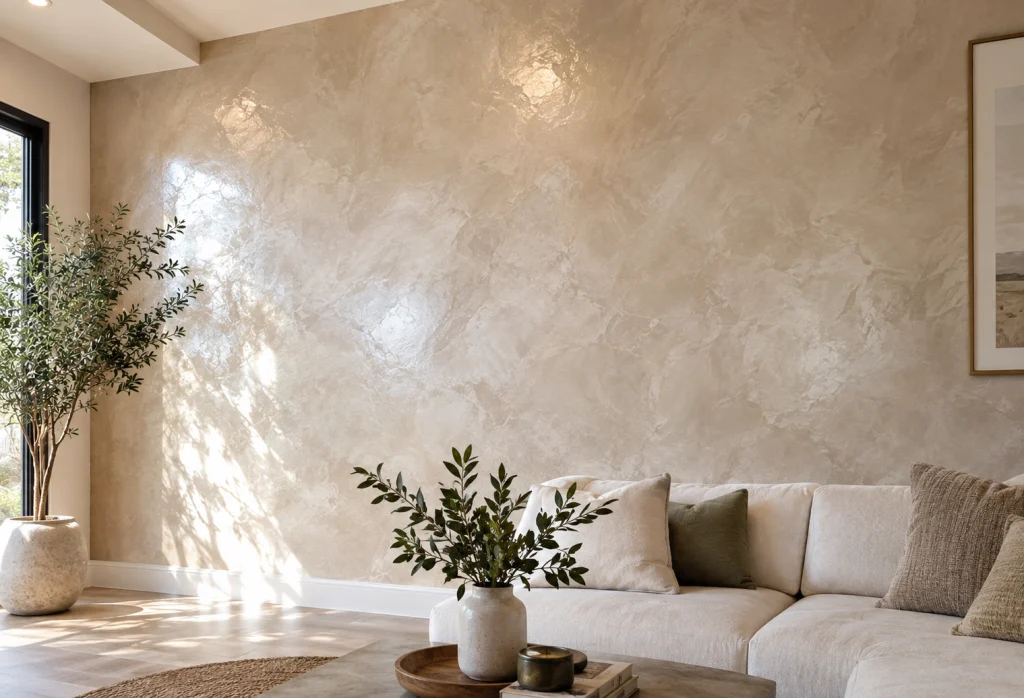
Surface depth separates Venetian plaster from an ordinary painted room. Interior plaster builds thickness in layers, catching light and shadow in ways paint typically does not. Vision Stucco applies Venetian plaster and polished plaster as premium options for homeowners and designers who want a finish with texture and character, not just a change in color.
Plaster wall systems offer a different aesthetic and tactile quality than standard drywall and paint, which explains renewed interest among architects and homeowners updating older properties or building new estates. Paint sits on a surface as a coat applied over the existing wall, while plaster is troweled on in layers to build texture and depth. Paint remains the more economical and lower-maintenance option for homeowners who prioritize budget, quick turnaround, or the flexibility to change colors often.
Is Venetian Plaster Better Than Paint?
Whether Venetian plaster or paint is “better” depends on what a homeowner values most. Paint creates a surface coating that can be reapplied relatively easily, while Venetian plaster is troweled in multiple thin layers and burnished to a marble-like sheen. That layered application can hold up well against everyday contact, but it requires a larger upfront investment and specialized application than paint.
Venetian plaster offers three defining traits:
- Precision: every layer applied to exact thickness and consistency
- Resilience: a finish that can hold up well to humidity and daily wear when properly applied
- Design intention: texture and tone matched to each space’s character
Paint remains the practical choice for homeowners who want a quick refresh, a lower price point, or the freedom to update colors on a shorter cycle. Traditional plaster craftsmanship, paired with modern techniques, produces smooth plaster walls and Venetian plaster walls that offer a level of texture and depth paint does not.

How Does Venetian Plaster Compare to Paint?
Venetian plaster creates visual depth through hand-applied layers, while traditional paint provides a more uniform surface finish. Applying interior plaster by hand is a process that reflects craftsmanship shaped by intention, rather than a routine roller-and-brush job. That distinction is what separates a luxury wall finish from an ordinary painted surface, though it also means a longer application timeline and higher labor cost than paint.
Texture is where the comparison becomes clear. Plaster finishes range from smooth plaster walls with a sand-free, glass-like surface to heavier sand textures or crow’s-foot patterns, depending on the desired look. Paint offers less of that dimensional range, since it is designed to provide even, consistent coverage rather than texture, but it is faster to apply and easier to touch up.
| Factor | Venetian Plaster | Paint |
|---|---|---|
| Texture options | Smooth to heavily textured | Varies by surface and application, with multiple sheen options |
| Longevity | Can hold its finish well over time when properly applied | Typically needs repainting on a more regular cycle |
| Application | Hand-applied, custom | Rolled or sprayed |
| Upfront cost | Higher | Lower |
| Color changes | Requires specialized rework | Quick and inexpensive |
Is Venetian Plaster Worth the Investment Over Paint?
Properly installed polished plaster can hold its finish well over time, which may help offset the higher upfront cost by reducing how often repainting is needed. That said, paint remains the more affordable and flexible option for homeowners on a tighter budget or those who like to update their color scheme frequently. Weighing lifetime value against upfront cost, and how often a look is likely to change, helps homeowners decide which finish fits their situation.
Can Venetian Plaster Be Used in Any Room?
Venetian plaster can work well in living rooms, entryways, bedrooms, and other interior spaces. In bathrooms or moisture-prone areas, suitability depends on the specific plaster system, surface preparation, sealing, and level of moisture exposure. Paint, meanwhile, is often the more practical choice in spaces like children’s rooms or rental units, where frequent color changes or low-cost touch-ups matter more than texture.
How Should Homeowners Decide Between Venetian Plaster and Paint?
Choosing between Venetian plaster and paint comes down to weighing a few practical factors rather than assuming one option is automatically better. Budget, timeline, desired texture, and how a space is used all play a role in the decision.
What Should Homeowners Consider Before Choosing?
The right finish depends on priorities. A homeowner focused on a fast, budget-conscious refresh will likely favor paint, while one seeking dimensional texture and a finish built to last will lean toward Venetian plaster.
Key factors to weigh include:
- Budget: paint costs less upfront; Venetian plaster requires a larger initial investment
- Timeline: paint can be completed quickly; plaster application takes longer due to multiple hand-applied layers
- Desired texture: paint provides even, consistent color; plaster offers a range of textures from smooth to heavily textured
- Maintenance tolerance: plaster can hold its finish well when properly applied; paint may need more frequent touch-ups or repainting
- Flexibility: paint makes future color changes simple; changing a plaster finish is a more involved process
FAQ
Common Inquiries
What makes Venetian plaster different from paint?
Venetian plaster builds depth in multiple hand-troweled layers, catching light and shadow that paint typically does not. Traditional paint creates a more uniform surface finish and is generally faster and simpler to apply.
Is Venetian plaster more expensive than paint?
The right finish depends on priorities. A homeowner focused on a fast, budget-conscious refresh will likely favor paint, while one seeking dimensional texture and a finish built to last will lean toward Venetian plaster.
Key factors to weigh include:
- Budget: paint costs less upfront; Venetian plaster requires a larger initial investment
- Timeline: paint can be completed quickly; plaster application takes longer due to multiple hand-applied layers
- Desired texture: paint provides even, consistent color; plaster offers a range of textures from smooth to heavily textured
- Maintenance tolerance: plaster can hold its finish well when properly applied; paint may need more frequent touch-ups or repainting
- Flexibility: paint makes future color changes simple; changing a plaster finish is a more involved process
How long does Venetian plaster last compared to paint?
Properly installed Venetian plaster can hold its finish well over time, while painted walls generally need repainting on a more regular cycle to stay fresh.
How long does it take to apply Venetian plaster versus paint?
Venetian plaster takes longer to apply because it is troweled on by hand in multiple thin layers that each need time to set. Paint is typically rolled or sprayed on in one or two coats, making it the faster option for a quick refresh.
Can Venetian plaster be painted over or changed later?
Changing a Venetian plaster finish is a more involved process than repainting a wall, since it may require specialized preparation or rework rather than a simple coat of paint. Homeowners who expect to update their color scheme often may find paint more practical for that flexibility.
Does Venetian plaster work in bathrooms and other humid spaces?
Venetian plaster is used in bathrooms and other humid areas, with texture and application adjusted to suit the space. As with any wall finish, proper application matters for how well it performs in moisture-prone rooms.
CONCLUSION
In closing, the choice between Venetian plaster and traditional paint comes down to depth, durability, maintenance, and long-term value, and neither option is automatically the better choice for every homeowner. Venetian plaster offers a hand-applied, textured finish built to last, while paint offers a faster, more affordable path to a fresh look with easy flexibility for future changes. Understanding these trade-offs helps homeowners and designers choose the finish that best fits their budget, timeline, and design goals.
Contact us
Considering Venetian Plaster for Your Home?
Choosing between Venetian plaster and paint is easier with an expert perspective on your space, budget, and design goals. Vision Stucco works with homeowners and designers across Southern California on custom Venetian plaster and polished plaster finishes.